€10M Backing Positions SAIA Agrobotics to Reimagine Automated Growing

SAIA Agrobotics, a Netherlands-based spinout from Wageningen University & Research, has raised €10 million in Series A funding to accelerate the commercial rollout of its greenhouse automation system by 2026. The round, led by Check24 Impact with participation from the EIC Fund, Navus Ventures, and Oost NL, brings the company’s total funding to more than €20 million and signals rising investor confidence in the role of robotics and AI in controlled-environment agriculture.
The young company sits within a European horticulture sector that has long been recognized as a global leader in high-tech greenhouse production, yet even here, labor remains the defining bottleneck. Growers face persistent shortages, rising wages, and increasing pressure to produce more with less as demand for fresh produce is expected to rise between 30% and 50% in the coming decades. SAIA has spent the past six years developing a system aimed squarely at this constraint. Instead of sending robots through narrow aisles and dense canopies, an engineering challenge that has stalled many automation attempts, the company has restructured the greenhouse itself. Plants are transported to stationary robots, which scan, trim, and harvest them under controlled conditions. The inversion sounds simple, but it allows SAIA to remove the hardest part of automation while unlocking a 50% reduction in labor requirements and up to 20% higher yields.
Its first commercial deployment is already underway at Growers United, one of Europe’s largest cooperative growers. There, SAIA’s system is validating its weekly scanning and harvesting cycles, operating year-round within a standardized workflow that investors believe could redefine how horticulture scales. For CEO and founder Dr. Ruud Barth, this is a moment that reflects years of patient engineering and a broader reframing of what automated greenhouses can become. “We recently completed the world’s first automated greenhouse, where plants go to the robot once a week for scanning and harvesting,” he said. “We aim for a 20 percent increase in yields with a 50 percent total greenhouse labor reduction. This is a huge step forward in providing a local, resilient and sustainable food supply.”
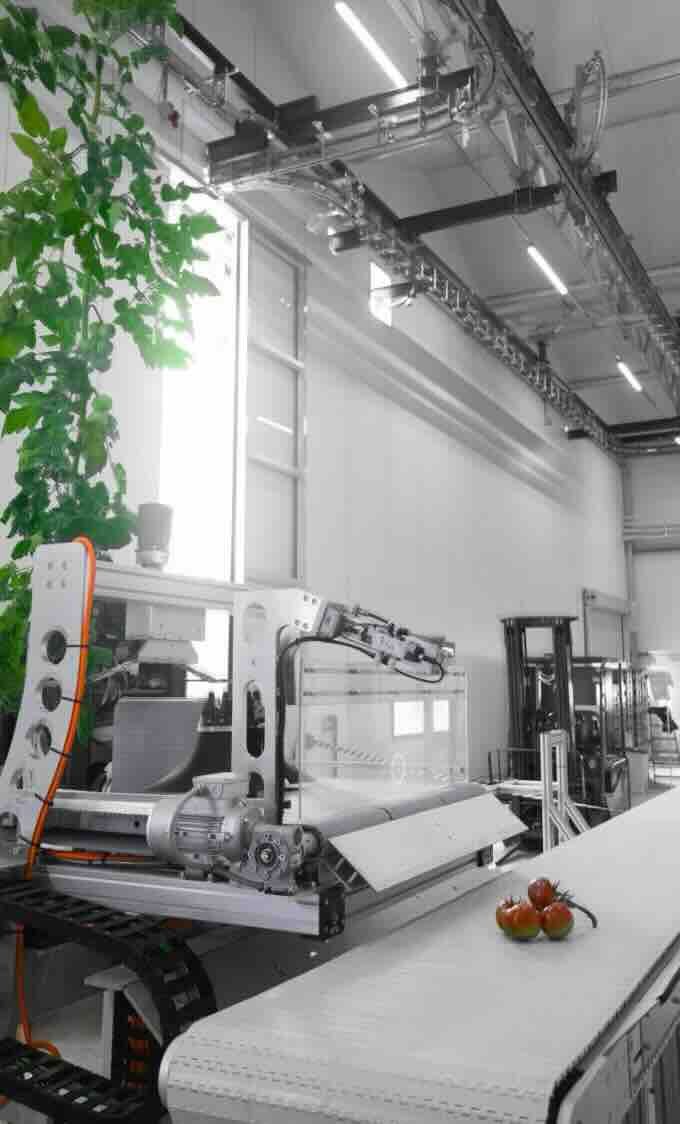
This standardized system also gives SAIA’s AI a level of visibility few competitors can match. Weekly data streams, captured through machine vision and sensors, build a continuous profile of plant development, stress, and productivity, allowing forecasting and quality control to shift from manual labor to software-driven insight. Over time, the company sees these capabilities forming the backbone of what it calls the “Food Factory of the Future,” a production model where crops move through an orchestrated sequence of robotic operations with the precision of an industrial line. This concept resonates strongly with investors who view the crossover between industrial automation and agriculture as both overdue and essential. “The product comes to the robot and not vice versa,” said Georg Heusgen, director at Check24. “There, under a standardized environment, robots can deleaf and harvest with an accuracy of over 99%, guaranteeing better product quality and the promised labor cost savings.”
The Series A round follows years of R&D, supported early by SHIFT Invest and Innovation Industries, and protected through a suite of international patents focused on plant handling and machine vision. For Oost NL, which reinvested in the latest round, SAIA’s progress over the last two years demonstrated readiness for scale. “Digitization and robotization are needed to produce sufficient healthy and sustainable food now and in the future,” said investment manager Wout Morrenhof. “SAIA has developed strongly over the past two years and is ready for the further commercialization of their product.” Navus Ventures echoed this confidence, noting the company’s alignment with its thesis on automation. “SAIA Agrobotics has developed innovative concepts in the field of plants, automation, and logistics, creating a new approach to greenhouse growing, with the potential to take a major step in efficient and sustainable food production,” said director Jaap Zijlstra.
The inclusion of the EIC Fund adds strategic backing at a moment when Europe is actively modernizing its agricultural infrastructure and supporting technologies that strengthen resilience. For the EIC, SAIA represents the kind of deep-tech approach capable of delivering measurable sustainability gains while easing long-term labor pressures, two challenges that sit at the heart of Europe’s food security agenda.
As SAIA prepares for its 2026 commercial rollout, the company is entering a market increasingly receptive to automated solutions that can maintain output despite demographic and environmental pressures. Its early partnership with Growers United offers a pathway for scaling across crops and regions, while its modular system could make it viable beyond the Netherlands as growers across Europe look for tools that can stabilize production without expanding labor needs. For an industry seeking greater predictability, the promise of year-round harvesting, data-rich operations, and industrial-grade precision may prove too compelling to ignore.


Comments